In high-demand industrial environments, electrical protection is not simply a compliance requirement; it is a critical layer of operational continuity. Facilities that rely on medium voltage switchgear, large horsepower motors, transformers, and power distribution centers must ensure that faults are detected and isolated immediately. Protective relays serve as the intelligence behind that protection. From gas processing plants and pipeline booster stations to petrochemical facilities and data centers, protective relays safeguard equipment worth millions of dollars. Moreover, they protect personnel and prevent extended downtime that can disrupt entire operations. When engineered correctly and integrated into a coordinated protection strategy, relays form the foundation of a resilient electrical infrastructure. This article explores the types of protective relays, how they function, and why proper integration into industrial power systems is essential.
What Are Protective Relays?
Protective relays are monitoring and control devices that detect abnormal electrical conditions and initiate isolation of affected equipment. Their purpose is straightforward: identify faults and trigger circuit breakers before damage spreads. At a functional level, every relay performs three essential tasks:
- Measurement: Electrical parameters such as current, voltage, frequency, and temperature are continuously monitored. These signals are typically received through instrument transformers.
- Evaluation: The relay compares measured values against predefined protection settings. If thresholds are exceeded, the relay determines whether a fault condition exists.
- Action: Once a fault is confirmed, the relay sends a trip command to the appropriate circuit breaker, hence isolating the affected portion of the system.
This sequence occurs within milliseconds. That speed is crucial when protecting medium voltage motors, transformers, generators, or feeders that could suffer catastrophic damage if faults persist.
The Role of Instrument Transformers
Protective relays do not directly measure high voltages or currents, because industrial systems often operate at levels far beyond what internal electronics can safely handle. To bridge that gap, relays rely on:
- Current Transformers (CTs): These step down high current values to manageable levels, often converting thousands of amperes to standardized values such as 1A or 5A.
- Potential Transformers (PTs) or Voltage Transformers (VTs): These reduce system voltage to safe measurement ranges.
Instrument transformers act as intermediaries, delivering scaled signals that preserve proportional accuracy. Without them, reliable protection would not be possible.
Types of Protective Relays by Technology
Protective relays have evolved significantly over the past century. Understanding their development helps clarify why modern systems favor digital solutions.
Electromechanical Relays
These legacy devices rely on magnetic coils, mechanical discs, and moving contacts. While simple and durable, they offer limited flexibility. Settings adjustments are manual, and multifunction capability is minimal. However, many older facilities still operate them, particularly in rural substations or aging industrial plants.
Static Relays
Static relays replaced mechanical components with solid-state electronics. As a result, they provide faster response times and better accuracy relative to their electromechanical counterparts. But these devices remain limited in data logging and advanced analysis features.
Digital and Numerical Relays
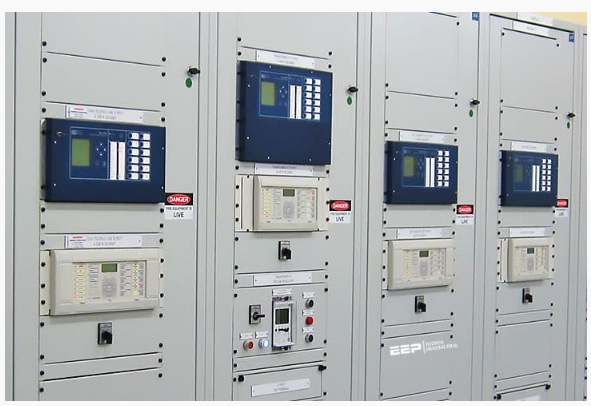
Modern protective systems use microprocessor-based relays. Often referred to as numerical relays, these devices perform multiple protection functions within a single unit. In addition, they provide self-diagnostics, event recording, fault analysis, and communication capabilities. Numerical relays support integration with SCADA systems and automation platforms, enabling the use of advanced communication protocols, such as IEC 61850, making them ideal for complex industrial facilities. Their adaptability allows engineers to implement coordinated protection strategies across entire power distribution centers.
Types of Protective Relays by Function
Protective relays are also classified according to the protection they provide. Each function addresses specific fault conditions.
Overcurrent and Voltage Relays
Overcurrent relays trip when the current exceeds safe limits, and are widely used to protect feeders, motors, and transformers from short circuits and overloads. While under-voltage and overvoltage relays protect equipment from dangerous deviations in supply voltage
Differential Relays
Differential protection compares the current entering and leaving equipment. If an imbalance is detected, it indicates an internal fault. Transformers and generators frequently rely on this protection.
Distance (Impedance) Relays
Distance relays calculate impedance to determine the location of faults along transmission lines. They are common in utility and large industrial distribution networks.
Directional Relays
These relays determine the direction of fault current flow. In interconnected systems, directional capability prevents unnecessary tripping of upstream equipment.
Reverse Power Relays
Reverse power protection is essential for generators. It prevents unintended motoring conditions that can damage prime movers.
Frequency Relays
Frequency deviations indicate supply-demand imbalance. These relays help stabilize systems during disturbances.
Thermal and Motor Protection Relays
Motor protection relays monitor thermal conditions, locked rotor scenarios, and phase imbalance. In facilities with large horsepower motors, this protection is critical to preventing insulation breakdown and mechanical failure.
Digital Signal Processing in Modern Types of Protective Relays
Numerical relays sample voltage and current waveforms thousands of times per second, enabling detailed analysis, including harmonic detection and phasor measurement. This digital signal processing allows relays to distinguish between transient disturbances and true fault conditions. Hence, reduces nuisance trips while maintaining fast response when genuine faults occur.
Event records and fault logs provide engineers with valuable diagnostic information after an incident. Having this data available improves troubleshooting efficiency and strengthens future protection coordination.
Integration Within Industrial Power Distribution Systems
Protective relays should never be treated as isolated components because their true value emerges when integrated into a comprehensive power system strategy.
In medium voltage switchgear lineups, relays coordinate feeder protection, transformer protection, and bus protection. In power distribution centers, they interface with variable frequency drives, motor control centers, UPS systems, and generator controls.
Effective integration requires:
- Short circuit analysis
- Protection coordination studies
- Arc flash analysis
- Relay settings validation
- Factory acceptance testing
- Commissioning and field verification
Without proper engineering, even the most advanced relay cannot deliver reliable system protection.
Industrial Applications of Protective Relays
Protective relays play a central role in multiple industrial sectors, with some examples as follows:
Oil and Gas
Pipeline booster stations, gas processing plants, and compressor facilities rely heavily on medium voltage motors. Relay protection ensures faults are isolated quickly, thus minimizing production loss and protecting high-value rotating equipment in the oil and gas industry.
Petrochemical Facilities
Continuous process operations, which are akin to petrochemical facilities, demand high reliability. Protective relays guard transformers, MCCs, and distribution feeders, preventing cascading outages.
Carbon Capture and Energy Transition Projects
Large compression systems and transport infrastructure in carbon capture and hydrogen production & storage systems require precise protection schemes. Coordinated relay systems support safe and stable operation in these evolving sectors.
Industrial Manufacturing
High-power motors, automation equipment, and distribution systems depend on properly coordinated protection to avoid costly downtime.
Data Centers
Redundant power architectures are a primary requirement in data centers, and they demand precise selectivity. Protective relays maintain uptime by isolating only affected circuits while keeping the remainder of the system energized.
Selecting the Right Protective Relay Strategy
Choosing the correct relay involves more than reviewing product specifications. Engineers must evaluate system characteristics, voltage levels, load types, and integration requirements.
Key considerations include:
- AC or DC system configuration
- Motor and transformer protection requirements
- Desired fault-clearing speed
- Communication protocol compatibility
- Environmental conditions
- Compliance with IEEE and IEC standards
Most importantly, relay selection must align with a broader protection philosophy. Selectivity and coordination across interconnected equipment determine whether a system remains stable during fault events.
Best Practices for Implementation and Maintenance of Types of Protective Relays
Proper deployment does not end with installation. Ongoing attention ensures long-term reliability with annual testing confirming functional performance. Moreover, firmware updates strengthen cybersecurity and expand capabilities, so they should be regular, alongside protection coordination reviews, whenever system modifications occur. Also, training personnel in relay operation and fault interpretation enhances response time during real-world events.
Engineered Protection for Industrial Power Systems from Paradigm Controls
Protective relays are essential components, but they are only as effective as the engineering behind them. In complex industrial environments, success depends on integrated design, thorough analysis, and disciplined commissioning.
At Paradigm Controls, protective relays are engineered as part of fully integrated power distribution systems that include medium voltage switchgear, motor control centers, variable frequency drives, and power distribution centers. Our approach combines protection studies, system integration, and field commissioning to ensure that every relay setting aligns with operational requirements. We believe that reliable protection is not achieved by installing devices alone, but via coordinated strategy, technical expertise, and long-term support. When properly integrated, protective relays safeguard assets, protect personnel, and maintain the continuity that industrial operations demand.
If you are evaluating upgrades, new installations, or modernization of legacy systems, Paradigm Controls can support the design and integration of a protection strategy tailored to your facility’s needs. Contact us today, and we will get started in delivering the most efficient and cost-effective solutions for your system.